Hi, hello and welcome back after a fantastic two months summer break ! I hope everyone has been able to recharge and get ready for a new season!
LA 1a) Name three sources of light and their specialties.
Sunlight – Is the most difficult light to shoot in, because it is constantly changing as the day goes by, and can’t be controlled as easily as artificial lighting. The golden hours, at sunrise and sunset, are the preferred times to shoot says the professionals. When taken in consideration, sunlight can give beautiful lighting and because it’s changing you as the photographer can be more spontaneous in order to get the best lighting.
Artificial light – Could be your cameras flash light, streetlight or a lamp in your living room. This light is highly adaptable and you are in charge, light bulbs can be changed and it can be moved as you wish.
Tea lights/ living light – This is the middle ground of my chosen lighting sources, the light is natural and can’t be changed, but the source can be moved. As I read through The Little Book of Hygge this summer, the importance of light is engraved in my mind. Tea light aren’t easy to capture in photos but I think it’s a great challenge.
b) Name two modifiers and what they are for.
Diffusers – Soft boxes and umbrellas are used to diffuse light. They softens the light by scattering it over an area lager than the light source it self.
Reflectors/ Absorbers – As the name suggest, reflectors reflect and absorbers absorb. A reflector helps when dealing with harsh lighting and dramatic shadows, reflectors bounces light of surfaces, softening, diffuses, or redirecting it elsewhere. For the opposite effect use the absorber to deepen the shadows and create a more dramatic look.
c) Draw a three-light studio setup.
A three -light setup consist of the following:
1. Key light – the main light source, was the most input and high contract in your scene.
2. Fill light – Secondary source, less contrast and dimmer than key light.
3. Separation light– third light source, separates the object from the background.

LA 2 a) Draw three setups for the following categories: portrait, beauty, fashion.
I don’t think this is meant to say there is one or a few correct ways of light setup, I believe any light setup can be used for whatever situation depending on what outcome you want.
Portrait- I drew up a dramatic setup with just a key light. As described in our reading material they suggested to have the key light and fill light above and below each other and the camera behind them, both lights with soft boxes, to create a soft direct light.
Fashion – Suggested with a key light modified with a grid and a reflector on the side.
Beauty – Suggested with a key light modified with a beauty dish and a reflector on the side.

b) Find each category in magazines and draw up how you think their lighting setup looks like.

Fashion- This one is obviously taken outdoors, I think they’ve used overcast daylight and a reflector to soften the shadows on her left side.

Portrait – This has a soft dramatic shadow. I think they’ve taken the photo by a window and with a reflector. Or the window was a few meters away from her, so the light is naturally soft.

Beauty – A classic three light setup or a setup of key light and a separation light.
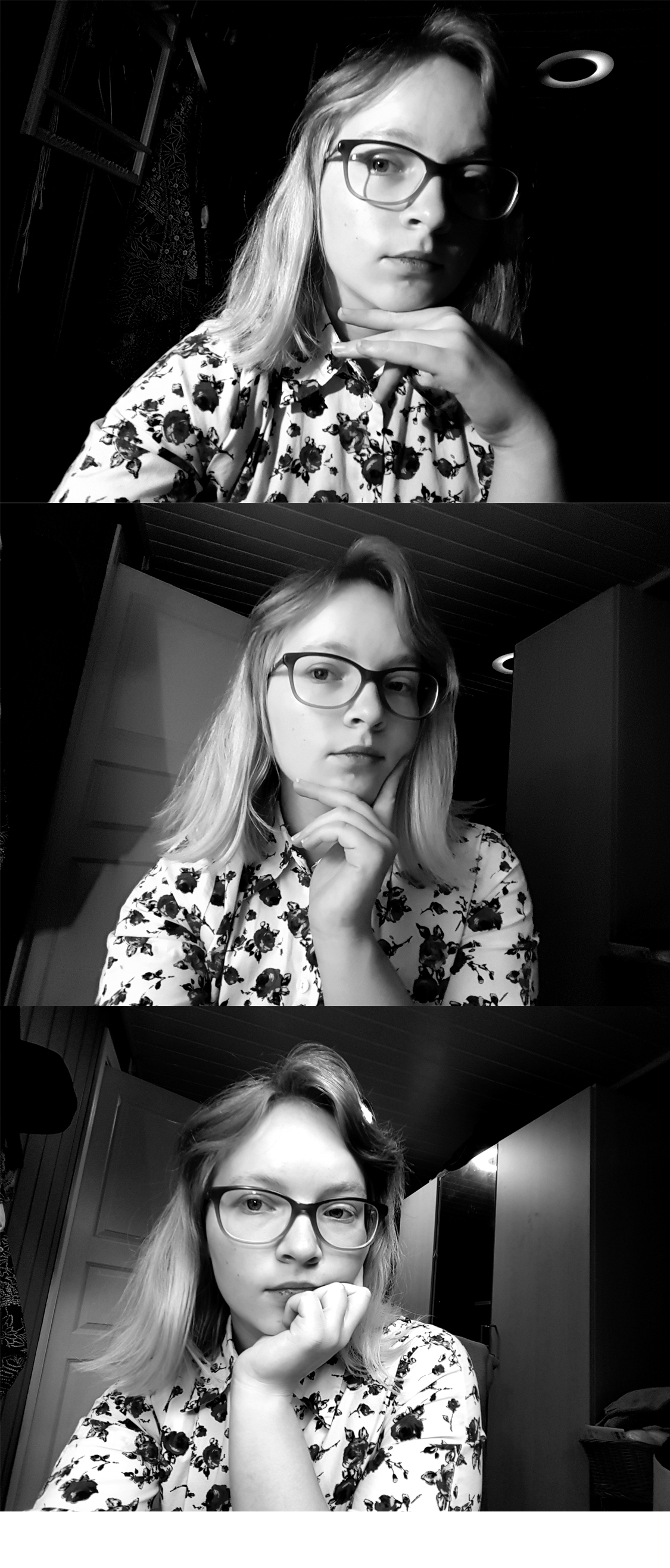
LA 3) Take a few portrait shots and take a extra look at the lighting, show different light settings eg. hard and soft light.
From the top down the lighting goes from hard to soft. At the top I assisted by my trusty reading lamp. In the middle I added the light from the floor lamp with it’s lampshade aka it’s softbox. And bottom picture is daylight, lamp and sealing light. I choose to present it in black and white to bring out contrast.
Sources
https://www.bhphotovideo.com/c/browse/Light-Modifiers/ci/19911/N/4062040414
and this week’s mandatory reading:
https://photo.tutsplus.com/articles/lighting-articles/an-introduction-to-indoor-and-studio-flash-photography/?search_index=2
https://www.photomatters.org/light
https://www.bhphotovideo.com/insights/blogs/photography/hard-medium-or-soft-light.html
https://photography.tutsplus.com/articles/a-fundamental-introduction-to-studio-lighting-equipment–photo-6067

 Designers Tea Party